August 16, 2011

And see where it takes us

I feel as though there's little I can say now to top the grandeur of Mt. Longonot, which, to be fair, has enough grandeur to overshadow a great many things. But the day before it had been just lovely as well, and I'd feel remiss if I were to just sweep it aside like a neglected toy.

On Saturday, I took an ex-pat field trip to Brown's organic farm outside of town for a cheese tasting and gourmet lunch. I hadn't originally planned to join the trip. I had already tried some varieties of Kenyan cheese and, quite frankly, wasn't much impressed. But I had nothing else to do, and I've learned over years of social trial-and-error that most of the best experiences come from simply saying "Yes." (File under: What DARE and Nancy Reagan don't want you to know).

Yes, let's get on this ferry and see where it takes us.
Yes, let's buy a cheap bottle of wine and sneak it down to the hot springs.
Yes, I will go ask Lewis Black to dance.

(Of course, there are some exceptions. Most notably, "No, I will not get in your van, no matter how much candy you offer me." And "No, I think I'll pass on the ruffies tonight, thanks.")

So with a free afternoon and a desire to get out of the city, I said "Yes, I will join the cheese excursion!" Or at least a moderately-enthused, "Sure, why not."

And it was lovely. Some days are simply made of beauty, and this was one of them. An elegant colonial farmhouse, set among the trees in a beautiful jungle.


Three happy dogs (including a puppy!) running around with tongues lolling out while piglets rolled in the dirt and Colobus monkeys played in the trees (or on the roof among climbing vines).

"That's right, chicken coop; I'm looking at YOU."

Link

We tasted white strawberries and cherry guavas picked straight from the garden. And when the rain came calling, we cozied up to the fire to sip wine and snack on grilled halloumi: Chili, yogurt mint, and lemon marinade.


Next, the official tasting of 11 homemade cheeses with scrumptious honey and chutneys. And just when you feel ready for a post-feast nap, out comes the gourmet lunch, all sourced from their organic farm and gardens.


There was also some cow-milking and a tour of the cheese-making facilities, but those details are a little foggy under the food-enchanted haze.

By the time we got back to Nairobi in the late afternoon, the rain was pouring down in buckets. With no appetite for a proper dinner, I baked a batch of banana-avocado bread and ate it warm with a bit more wine, while the rain nearly-but-not-quite drowned out the sound of my favorite movie. (The Station Agent, if you're wondering).

I can't think of much better.

August 15, 2011

The stunning expanse

It's Monday morning, and I am in pain. From the sunburn on my neck, through the tightness in my back, down to the soreness of my feet. But mostly it's my legs. My poor, unassuming legs, who had no idea what was being asked of them when they got out of bed yesterday.

Which is all to say that I have hiked the (reputed) highest volcano in the Great Rift Valley that runs from Lebanon to Mozambique, dividing Africa on two tectonic plates.


I know it looks like I Photoshop'd myself in, but I was there- at the top- honest! Behind me is the inside of the volcano backed by its highest peak, but what you can't see here is the mountain we already climbed to get to where I'm standing. And we lunched on the crater's edge:


Only about an hour's drive from Nairobi, Mt. Longonot rises approximately 2780 meters above sea level and produces magnificent views of Lake Naivasha and the valley below.


Not only did we hike up the mountain-- we then clawed and scrambled up steep slopes of loose lava pebbles to reach the highest peak and continued to trek along the narrow narrow path around the entire crater rim.


It's a journey not for the acrophobic or unsure-footed. The most trecherous part is the view: To the left, a volcano overhung with enchanting mist. To the right, the stunning expanse of the Kenyan Rift Valley. It's all breathtaking and bedazzling and just begging for one mis-step off the path to tumble your way back to the valley floor.

Scrambling up to the top:


And a view of crater and rift from the highest peak:


And words acquiesce to the power of nature.

August 9, 2011

A maze of corrugated tin

I don't remember when I began to hear about Kibera. I was certainly unaware of it upon arriving in Nairobi. The first few times it was mentioned, I probably siphoned it away with all of the other words I don't understand (cities, street names, Swahili dialects). But soon I came to know what a Google search can tell you in an instant: Kibera is a serious slum.


I took this picture from the grounds of the CDC Kenya. An international beacon of health overlooking notorious squalor; irony with a view.

If anyone saw The Constant Gardener with Ralph Fiennes and Rachel Weisz (which I did not because it looked scary and thus went against my never-watch-anything-scary-lest-you-have-nightmares-for-months policy), parts were filmed on location here. According to people who seem to know things, Kibera is either the first or second largest slum in Africa. There is another massive one in South Africa that may be larger, but apparently that one has wide-spread electricity so it's upgraded to something akin to Slum 2.0. Kibera is Slum Beta.

But this isn't a competition, and even if it were, it's impossible to get any kind of accurate population count. Varying estimates have listed the Kibera population as anywhere between several hundred thousand to several million.

Several million people living here:


Over 40% of the patients who receive HIV services at our clinic are residents of Kibera, and on Monday some of my coworkers took me in to see what it's like. I'll admit I was expecting something pretty awful. Michael told me stories of people who were vigilant about not leaving any valuables in their parked car, only to return and find all four wheels missing. I also heard about sewage running in rivers through the streets (which is true, especially after the rains), and the intense slum violence after the 2007 elections, where whole swathes of the town were torched and mobs uprooted these steel rails (the international railway from Mombassa to Uganda passes daily through Kibera):


But everyone knows that lowered expectations result in pleasant surprises. So, I've been sitting on this experience for a few days, mulling it over, trying to figure out a way to articulate my feelings above a third grade reading level, with minimum success. But I will still do my best:

I want to say that I enjoyed it. That I was pleasantly surprised by the sense of community I found, with shops and commerce all around (fruit stands, butcher shops, shoe stands, hair salons, CD stands), with lively music playing around each bend, no car traffic, and kids laughing in the streets.


We visited the Umande Trust BioCenter latrines where "human investments" (as they happily euphemize them) are converted into gas energy for heating stoves of a communal kitchen.


And we visited a school in summer session, which was made of nothing more than a maze of corrugated tin where you have to duck and climb a ladder to reach the second floor, but the children excitedly speak in unison, "Hi how are you visitors?We are fine.Thank you for visiting our school!" And I was pleasantly surprised that no one sent their kids to ask us for money (despite the dire need), as is often done on streets around the world. Instead, kids ran up to shake our hands and then ran off giggling and whispering.

"Motto: The roots of education are bitter, but the results are sweet."


But you can't ever admit to enjoying exposure to such extreme breaches of human rights and decency, where flying toilets act as an accepted solution to the threat of violence, where open sewage running through the streets brings contamination and disease to the kids playing in it, and where the average family lives on $1 USD per day. Perhaps what I mean to say is that I found parts of the experience to be uplifting where I expected nothing but an onslaught of despair. Or that it made me feel as though the work we do here has a direct impact on those most in need- that same sense of community connection I used to feel walking through the Tenderloin in San Francisco.

Or maybe I've realized a personal preference for open sewage vs. the unrelenting diesel smog that pervades the rest of Nairobi.

Mostly, I am left with the feeling that I would like to learn more. That I would like to go back, if opportunity presented itself. That this is a place in which I would possibly like to do future work. If only to suss out the feasibility of a SODIS community intervention, the first thing that jumps to mind when I see miles of corrugated roofing.


August 7, 2011

A fair note of mischievousness

Anjuli brought the sun from Bondo to Nairobi again to spend this weekend with me and Laura. At some moments I am overcome with the wild implausiblity and extraordinary nature of three friends drinking tea a half-globe way from Seattle. But the majority of times it feels perfectly natural to cook dinner, cavort, and simply sip tea together. Lots of tea. Yummm tea. As Jake aptly put it, home becomes the company that you keep, the place where your people are.

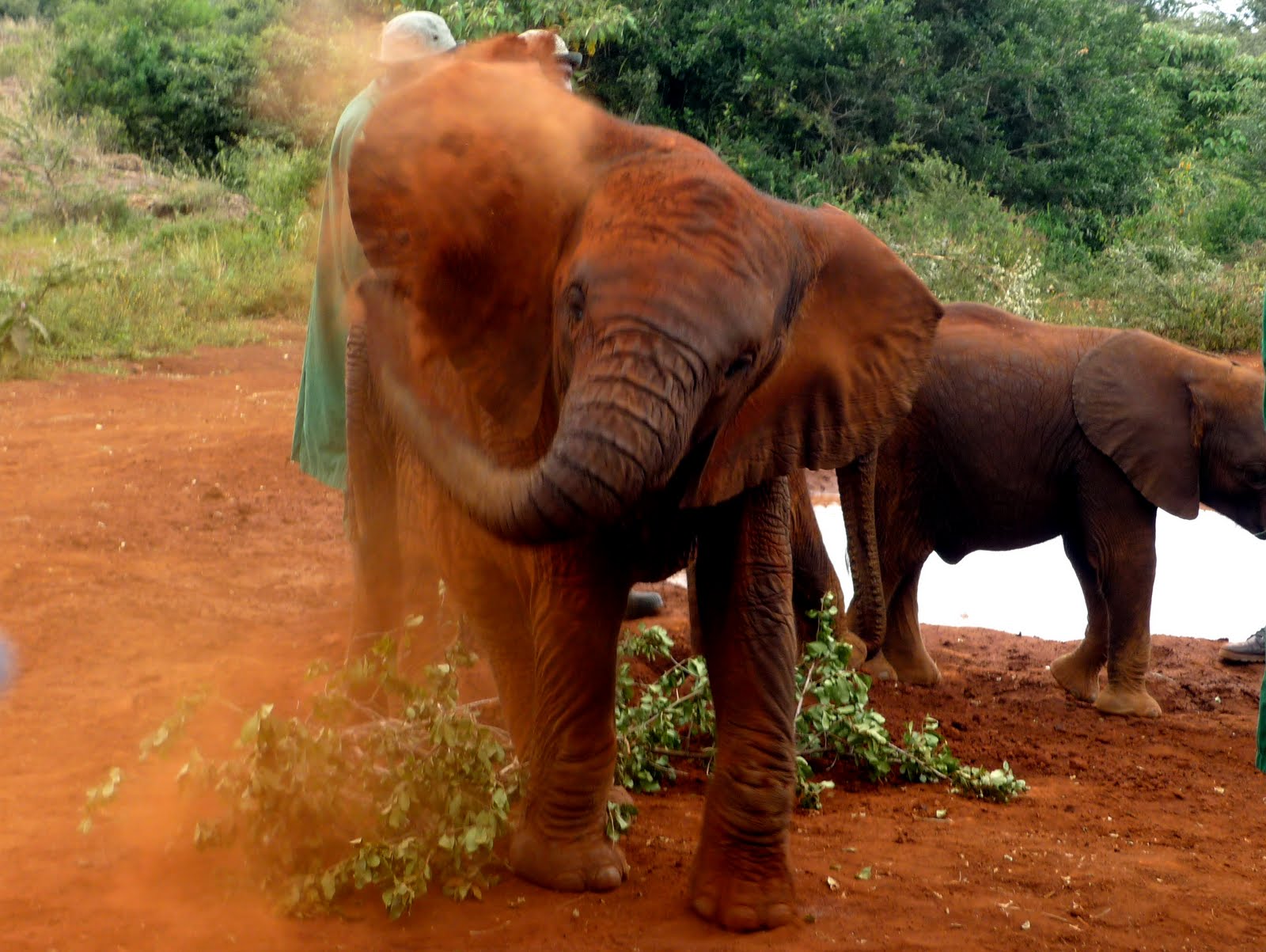
Today we took another tourist excursion to the David Sheldrick Wildlife Trust, where they raise baby elephants that have been orphaned and ultimately re-release them into the wild. Apparently, they have discovered that tourists are a litigious bunch:


Elephants are orphaned when their mothers are die at the hands or ivory poachers or from natural causes like droughts, and they do extremely poorly as orphans in the wild. Even in the conservatory, they need constant nurturing and attention. They are all fed a milk formula from bottles, and the really young ones (the youngest currently at the Trust is 3.5 months old) have keepers that stay with them 24 hours a day, including sleeping along side them in the stables! Perhaps the above warning is appropriate given that the babies like to suck/chew on people's hands, similar to infant thumb sucking. Not that the trainers are much heeding that advice...


They also like to toss dirt in the air, with a fair note of mischievousness.


And to snuggle/wrestle with each other. There are 11 elephants currently at the trust, ranging from 3.5 months to about 2 years, and they split them into 2 groups by age. Apparently the smaller one here (pictured below) was supposed to stay in the younger group, but she's so attached to the bigger one (they were rescued at a similar time) that when the bigger one graduated to the older group, they had to bring the young one along as well so she wouldn't be sad.


We also saw a rousing (sort of) game of soccer (football) between one of the elephants and a pack of warthogs.


After the elephants was a trip down Karen Blixen (Meryl Streep in Out of Africa) memory lane, but first a surprise detour to say hello to some nit-picking gorillas. Gotta stay groomed!


And finally, the most delicious curry-buffet lunch ever consumed, in the beautiful Karen Blixen gardens. Western menu prices and chalk-full of mzungus (white people/foreigners) with some vaguely uncomfortable reminders of the colonial days, but out-of-this-world food.


And delightful company.

August 5, 2011

Or to sit here

I was living in Athens when I first heard about Facebook, and I thought it was simply silly. I thought it was a narcissistic fad (says the blogger) that would pass just as quickly as Friendster and all the rest. Six years later, I am in awe at the ways in which social media now shapes our world. When I watch CNN at breakfast (my only English TV channel), they replay homemade YouTube videos from Hama because they’re not allowed to report within Syria. Facebook messages and wall postings mobilized enough people in Tunisia and Egypt to topple regimes. “Kenyans for Kenya” has raised the equivalent of a million US dollars in less than a week for famine relief, through the use of SMS text messages. My boss wants to facilitate communication between Vietnam, Kenya, and Seattle by having us all sign up for Twitter.

I remember when globalization used to mean the spread of goods and ideas through increasing international trade and travel; now ideas can spread increasingly farther and faster than planes are able to fly. (Even just now, I Google’d the difference between ‘further’ and ‘farther’ as I like to be precise, if possible, and that’s one of those pairs that has always troubled me).

Perhaps my awe of the information age is anachronistic and seems more apropos for the 1990s. But I feel changes in ways I’m not sure I’m equip to express. Yesterday afternoon I was preparing to enjoy a quiet evening at home with sweatpants, wine or tea (I had not yet decided), and a book, but ended up enjoying grilled Halloumi and locally brewed beer at a rose-petaled and candle-lit table with five friendly strangers (or strange new friends): American, American, British, Irish, Indian.

The loneliness of travel and feeling foreign becomes less intense when you know you can simply log onto a website and find others “like you.”

Perhaps if I had known this six years ago, I would have decided to give Facebook a chance earlier. Perhaps I would have spent Thanksgiving eating turkey and cranberry sauce with a group of fellow Americans. That might have been quite lovely.

But it may have also meant missing the opportunity to enjoy a chance-encounter Thanksgiving lunch with the Cyprus' chess master, which was also quite lovely. Or to sit here, alone, at the edge of Corfu with my own thoughts.

Which is better?

August 2, 2011

The secret garden

To further illustrate my point about the "secret garden" nature of the restaurants here (and because I just took these pictures), I present...

The stark gated entrance to Masawry Egyptian restaurant:


And the oasis with plush benches, flowers and playground just beyond:

August 1, 2011

Wow them with my filleting

Since arriving in Nairobi 4 weeks ago (I'm celebrating my 1 month anniversary on the 5th!), I have partaken of the following cuisines: Kenyan (duh), Egyptian, Ethiopian, Korean, Lebanese, Japanese, Meat (yes, apparently carnivorous is a cuisine) and American (brunch).

Kenyan food is fairly straight-forward: Choose your meat (beef, chicken, goat or fish), choose your starch (rice, chapati, or ugali), and typically served with sauteed collared greens or cooked cabbage, sometimes a fresh tomato salad. Chapati is the Kenyan version of a pita or naan type bread, and ugali is a starchy blob that tastes like cream of wheat that's been boiled down until it becomes a sticky solid lump. As I happen to like fish, greens, and cream of wheat, this diet works rather well for me.

The first time I went to a Kenyan restaurant with some coworkers, they asked (with some sense of amusement) if I had ever seen/consumed a fish that was served its entirety. Having both lived in Greece and also worked in a restaurant where I was trained to serve and prepare large sea bass by cutting off the head, tail, and removing a full fish skeleton, I smirked, thinking that I would wow them with my filleting skills. As usual, the joke was ultimately on the foreigner, because you eat all of this with your HANDS.


Actually, etiquette dictates you eat it with ONE hand (the right), although I have seen other people using two, so it seems to be a loose rule. But either way, that is one messy messy lunch. The lack of an "after" picture denotes my desire to preserve the hygienic integrity of my camera for as long as possible.

As for the "meat" cuisine (style akin to a Brazilian steak-house with exotic fare), one can find more details and pictures from Laura, but suffice it to say, I consumed camel, ostrich, and crocodile. The fiery circle where all skewers meet (meat, ha) their fate:

Link
One of my favorite things about dining out in Nairobi are the restaurants themselves. Consistent with the other high levels of security, they are gated and look like nothing more than private driveways from the main road. This is the entrance to the Korean place where I had the lovely patio party last week:


But then you go inside and find delightful gardens with patio tables, soft music, dusk lighting, and playgrounds for children. Here, the Egyptian restaurant with lovely ambiance, hookah aroma, and delicious food:


Of course, it's not all dining out seven days a week... I do have a kitchen where I keep and make food. In fact, my kitchen is currently housing fresh mango, dried mango, and mango juice. And some African wine (though Chilean, Spanish, and Italian are also readily available at grocery stores).


And tea. Lots of tea. Most people here take it with much milk and sugar, but that's not really my thing. In fact, after trying a few rounds of Kenyan milk, I've given up on cereal and developed a new breakfast routine: Black tea, fresh papaya, and bread with strong African honey.


Breakfast of Champions? Don't mind if I do!